Football Betting – Understanding Odds, Markets, and Responsible Decision-Making
Football is watched by millions of people around the world, and online platforms have made it easier to follow fixtures, statistics, and betting markets in real time. For new users, however, football betting can initially appear complicated because a single match may include many different market types.
Understanding the structure of those markets is more useful than immediately trying to predict results. Odds, handicaps, total goals, form, and team news all require proper interpretation.
What is football betting?
The term kèo bóng đá refers broadly to betting markets associated with football matches.
These markets allow users to consider different possible outcomes, from the final result to the number of goals scored.
The exact options vary by match and competition.
Before selecting any market, users should understand its rules and settlement conditions.
Two choices that look similar may operate differently.
Reading the market description first can prevent unnecessary confusion.
The match-result market
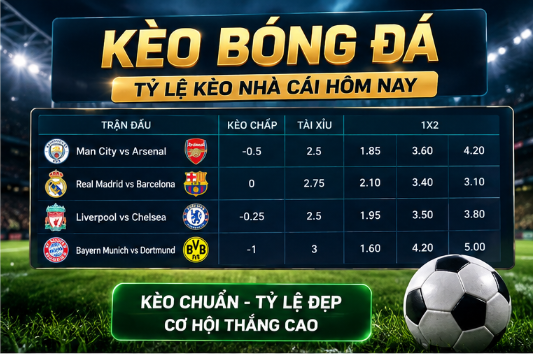
One of the simplest market types is the standard match result.
In many competitions, users can choose between a home win, draw, or away win.
The associated odds reflect the market’s assessment of each outcome.
However, a low price should never be interpreted as certainty.
Favorites lose regularly in football.
A stronger squad may still be affected by injuries, tactical problems, red cards, or an unusually strong performance from the opponent.
Asian handicap markets
Asian handicap markets are designed to create a more balanced comparison between two teams.
The stronger side may be assigned a handicap, while the weaker team receives an advantage.
Different handicap levels create different settlement conditions.
Users should understand the exact line before making a selection.
Simply choosing the stronger team without considering the handicap can lead to misunderstandings.
The margin of victory may become just as important as the match result itself.
Total goals markets
Goals markets focus on whether the combined number of goals will finish above or below a specified line.
To evaluate these markets, users often examine attacking and defensive records.
However, averages alone are not enough.
The tactical approach of both teams matters.
A team that normally attacks aggressively may play more cautiously in an important knockout fixture.
Likewise, two defensive teams can occasionally produce a high-scoring match because of early goals or individual errors.
Using recent statistics properly
Recent form is useful when viewed with context.
Five consecutive wins may look impressive, but users should check the quality of the opponents.
It is also useful to separate home and away performances.
A club may be dominant in its own stadium while struggling on the road.
Goals scored, goals conceded, shots, and possession can add more information.
Still, no statistic should be treated as a guarantee of the next result.
Accessing football market information
Users can visit kèo nhà cái when reviewing football markets and related match information.
When comparing odds, it is important to remember that prices can change.
Team news, injuries, lineup announcements, and market activity may all contribute to movement.
Users should avoid assuming that every change contains a hidden prediction.
Market movement is only one source of information and should be interpreted alongside football analysis.
The importance of team news
A major injury can have a significant effect on a football match.
The absence of a first-choice goalkeeper, central defender, midfielder, or leading scorer may change the tactical plan.
However, the impact depends on squad depth.
Large clubs may have high-quality replacements, while smaller teams can struggle when one key player is missing.
Checking confirmed lineups before kickoff can therefore provide valuable information, especially when early reports are uncertain.
Motivation and match importance
Not all fixtures have the same competitive meaning.
A title-deciding match may be approached differently from a low-pressure mid-table game.
Teams fighting relegation can show greater intensity late in the season.
Cup matches also create unique situations, especially when played over two legs.
A team protecting an aggregate lead may focus on defense, while the trailing side has to take more attacking risks.
This context can influence both result and goals markets.
Avoid emotional betting
Football supporters naturally develop strong attachments to particular clubs.
However, loyalty can interfere with objective analysis.
A fan may overestimate the chances of a favorite team or ignore negative information.
A more disciplined approach is to review the same factors regardless of which team is playing.
Users should also avoid placing selections simply because a match is being televised or because friends are betting on it.
Every decision should remain independent.
Chasing losses increases risk
One of the most dangerous behaviors in betting is trying to recover previous losses by increasing stake size.
A lost bet does not improve the probability of the next selection.
Each football match remains uncertain.
Increasing stakes under emotional pressure can turn a small loss into a much larger financial problem.
Users should decide on both a session limit and an overall bankroll limit before beginning.
Once the limit is reached, stopping is the responsible action.
Football betting is not guaranteed income
No system, tipster, statistical model, or betting strategy can guarantee profit from football.
Even professional analysts make incorrect predictions.
Unexpected events are part of the sport.
Users should therefore treat betting as optional entertainment rather than a method of earning regular income.
Money required for essential expenses should never be used.
Age restrictions and local laws should also be checked before participation.
Conclusion
Football betting includes a wide range of markets, from simple match results to handicaps and total goals.
Understanding those markets requires attention to rules, team form, injuries, tactics, scheduling, and match context.
Odds can provide useful information, but they cannot guarantee what will happen on the pitch.
Responsible participation means accepting uncertainty, protecting personal finances, and maintaining strict limits.
The more clearly users understand both the football and the risks involved, the better equipped they are to make controlled decisions.