Beyond Visibility: What the 90T–Crystal Palace Partnership Must Prove in Asia (or known as 90t.asia)
Introduction: a partnership announcement is only the starting point
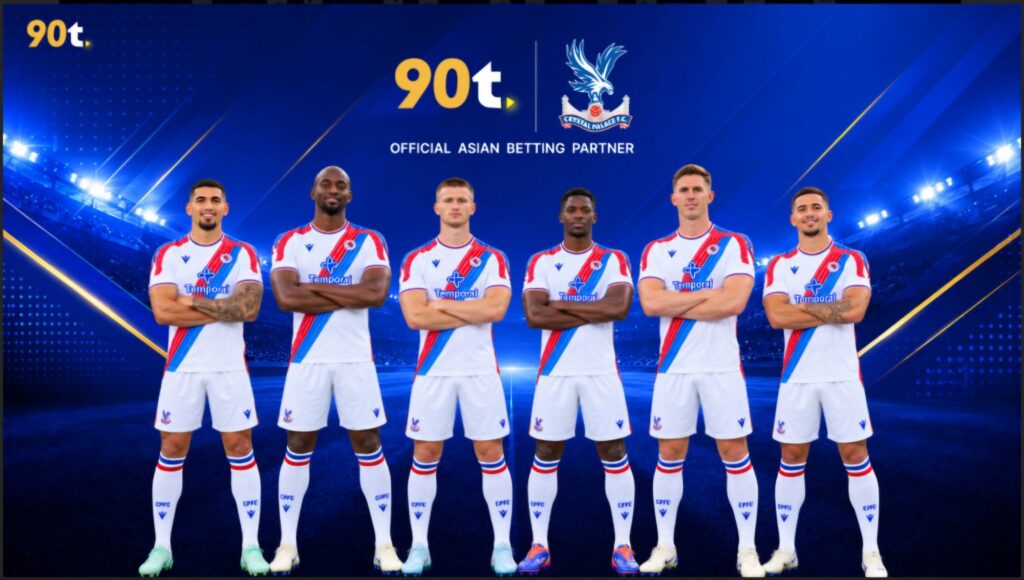
The 90T–Crystal Palace F.C. partnership for the 2026/27 season is easy to understand at a commercial level. Crystal Palace gains another route into a large and highly active Asian football audience, while 90T gains visibility through association with an established English football club. On paper, the logic is straightforward.
The more difficult question is what happens after the announcement.
In modern football marketing, visibility can be purchased relatively quickly. Trust, relevance and emotional connection cannot. The distinction matters particularly in Asia, where supporters have access to almost every major European league, club and player through digital platforms. Competition for attention is intense, and fans can distinguish between a brand that merely appears around football content and a partner that contributes something meaningful to their experience.
For that reason, the 90T–Crystal Palace relationship should be assessed less by the scale of its launch message and more by what it produces over the course of the season. The partnership has potential, but its long-term value will depend on execution, transparency, localisation and whether supporters can identify a clear benefit beyond brand exposure.
Crystal Palace has a story to tell — but that story still has to travel
Crystal Palace F.C. has several assets that can support international growth: a long club history, a recognisable identity, a distinctive home environment at Selhurst Park and a committed supporter culture. Those qualities are valuable because football fandom is rarely built on match results alone. It is also built on stories, rituals, memories and a sense of belonging.
However, none of those qualities automatically translate into stronger awareness in Asia.
The English football market is crowded with globally recognised clubs that have spent years building local fan communities, producing region-specific content and maintaining regular contact with supporters outside the United Kingdom. Crystal Palace therefore faces a different challenge from simple audience acquisition. It has to explain why its identity matters to a supporter who may already follow several English teams and who is exposed to a constant stream of competing football content.
A regional partner can help accelerate that process, particularly if it understands local digital behaviour and can support distribution in Southeast Asia and other Asian markets. Yet the club’s identity must remain central. If localisation becomes little more than translation and logo placement, the campaign may widen reach without deepening affinity.
The real test is whether sponsorship becomes an experience
The most encouraging part of the proposed collaboration is not the visual exposure attached to the partnership title. It is the possibility of fan-facing activity.
Plans mentioned around official match-viewing events, club and stadium experiences and other supporter initiatives suggest an ambition to move beyond passive sponsorship. That distinction is important. A logo can be seen and forgotten. A well-executed supporter event can create a memory, a community and a reason to remain connected to the club.
Official watch parties, for example, can give supporters a regular physical meeting point. Club or stadium visits can give Asian fans access to the history and atmosphere they normally experience only through a screen. Digital content can extend those moments, especially if it is created around local fan stories rather than simply republishing global campaign assets.
But these activities should not be treated as proof of success merely because they are announced. Their frequency, accessibility, geographic reach and quality will matter. A single high-profile event in one major city may generate photographs and social media impressions without creating a durable supporter network. Long-term value requires repetition.
Asia is not one audience
Any assessment of the partnership also has to avoid treating “Asia” as a single market.
Supporter behaviour in Vietnam, Malaysia, Indonesia, Thailand, Singapore, Hong Kong, Japan or South Korea can differ significantly in language, platform preference, viewing times, content style and local football culture. Even within Southeast Asia, audiences do not necessarily respond to the same creators, messages or event formats.
This is where localisation becomes more demanding than translation.
Effective localisation may require different social channels, different publishing schedules, different creative formats and different community partners. In some markets, short-form video may dominate discovery. In others, supporter groups, football media pages or live viewing events may have greater influence. The tone of communication also matters: content that feels natural in one market may feel generic or overly commercial in another.
90T’s regional market knowledge could be useful here, but the partnership should ultimately be judged by evidence of market-specific execution. A broad claim of Asian reach is less meaningful than a visible pattern of relevant local activity.
Visibility without credibility can create diminishing returns
Commercial partnerships in football often begin with a simple objective: increase exposure. That remains a legitimate goal, but exposure alone is becoming a weaker measure of success.
Supporters now encounter sponsorship messages constantly — on shirts, LED boards, digital posts, match graphics, video content and event materials. Repetition may increase recognition, but it does not guarantee positive sentiment. In some cases, excessive commercial messaging can have the opposite effect if fans feel that brand communication is crowding out football content.
This makes credibility an important part of the 90T–Crystal Palace equation.
The partnership will need clear messaging about what supporters can expect, consistent delivery against those expectations and a visible balance between commercial objectives and fan value. If supporters see useful content, accessible experiences and genuine community activity, the brand relationship may become more credible. If the partnership remains dominated by promotional exposure, its impact may be short-lived.
For an industry observer, this is one of the most important points to watch: whether the relationship develops an identity of its own or remains another sponsorship layer around existing football media.
Responsible promotion will influence long-term trust
The nature of the commercial category also makes communication standards particularly important. Partnerships connected to betting and digital entertainment attract additional scrutiny because football audiences include younger supporters and because regulatory expectations differ across markets.
That does not mean such partnerships cannot create value. It does mean that visibility should be accompanied by clear safeguards, appropriate audience targeting, transparent promotional language and a responsible approach to content distribution.
For both parties, long-term trust is likely to depend partly on how consistently these boundaries are respected. A partnership that expands quickly but creates questions about audience protection or promotional transparency can damage the very credibility it is intended to build.
From a cautious industry perspective, responsible execution should therefore be treated as part of the commercial strategy rather than as a separate compliance exercise. Brand growth and brand trust are not independent outcomes.
The partnership needs better metrics than impressions
If the objective is to build a stronger presence in Asia, the most useful indicators will go beyond reach and impressions.
Useful measures could include the growth of Crystal Palace supporter communities in specific markets, repeat participation in viewing events, engagement with locally produced content, growth in region-specific social channels, the number of supporter-led activities that continue beyond a single campaign and the quality of feedback from fans who attend official experiences.
Retention may be particularly important. A supporter who attends one event because of a promotion is different from a supporter who returns, joins a community and continues following the club.
The same principle applies to content. A viral post can generate a temporary spike in awareness, but sustained engagement with localised football stories is a stronger sign that the partnership is creating relevance.
These measures are harder to communicate than a large impression figure, but they are more useful in determining whether the relationship is building a durable audience.
What should industry observers watch during the 2026/27 season?
The first months after launch will reveal whether the partnership is being treated as a genuine regional programme or primarily as a sponsorship asset.
Several questions deserve attention. Are fan activities held regularly or only around major announcements? Are multiple Asian markets included, or does activity concentrate on one or two locations? Is local content genuinely adapted to each audience? Are supporter groups involved in the planning and delivery of events? Does the partnership create more access to the club, or mainly more exposure to the partner brand?
Equally important is continuity. Many commercial partnerships launch with strong publicity but become less visible once the initial campaign cycle ends. The stronger test will be whether 90T and Crystal Palace maintain activity during less prominent periods of the season and whether their regional programmes develop over time.
The answer will determine whether the collaboration becomes part of Crystal Palace’s wider Asian growth strategy or remains a short-term commercial initiative.
Conclusion: the opportunity is credible, but the evidence still has to follow
The 90T–Crystal Palace partnership has a clear commercial rationale. Crystal Palace wants deeper access to Asian supporters; 90T can benefit from closer association with English football and a club with a distinctive identity. The planned fan activities also create the possibility of a relationship that extends beyond conventional visibility.
Still, the most important claims cannot be proven at launch.
A partnership becomes strategically valuable when supporters can see, participate in and remember what it creates. That requires local relevance, consistent delivery, careful communication and clear attention to responsible promotion. It also requires patience: supporter trust develops more slowly than brand awareness.
For now, the collaboration should be viewed as a promising platform rather than a finished success story. The 2026/27 season will provide the evidence. If the partnership produces recurring fan experiences, meaningful local content and stronger supporter communities, it may offer a useful model for how a mid-sized English club can expand its Asian presence. If it remains centred on visibility, the long-term impact is likely to be more limited.
Five points to monitor during the 2026/27 season
- Whether fan events are repeated consistently across the season rather than concentrated around launch periods.
- How deeply content is localised for individual Asian markets instead of simply translated.
- Whether supporter participation develops into repeat engagement and identifiable local communities.
- How clearly commercial messaging is balanced with fan value, transparency and responsible promotion.
- Whether the partnership leaves measurable value beyond the 2026/27 season.
FAQ
What is the 90T–Crystal Palace partnership for the 2026/27 season?
Based on the supplied partnership description, 90T is positioned as Crystal Palace F.C.’s official Asian betting partner for the 2026/27 season, with the collaboration intended to strengthen regional visibility and fan engagement.
Why is Asia important to the partnership?
Asia contains large and highly active football audiences, but the region is fragmented by language, platform preference and supporter culture. This creates both an opportunity and a localisation challenge for the partnership.
Why should the partnership be assessed cautiously?
Because brand exposure does not automatically become fan trust or long-term community growth. The more meaningful test is whether the partnership delivers recurring, localised and responsible experiences that supporters value.
Editorial note
This article is written as independent commentary and industry observation based on the supplied partnership description. It is not intended to function as an official statement from Crystal Palace F.C. or 90T.