
Triple Card Poker runs by matching participant hands against the house dealer without involving any opponents. The primary objective directs individuals to build the highest combination using exactly 3 randomly dealt elements. Draft analytical frameworks on go88 to decode hidden sequences during upcoming mathematically driven card rounds.
Analyzing Triple Card Poker rules for participating members
Grasping the structural foundation requires a detailed look into how cards are distributed across the table. Members on go88 evaluate initial combinations before deciding whether to proceed with extra wagers immediately.
Defining the basic card hierarchy mechanics
Understanding value orders remains crucial for individuals aiming to calculate potential victory margins accurately beforehand.
- The standard sequence places straight flushes at the absolute peak of the overall scoring pyramid.
- 3 matching symbols represent the second highest tier capable of dominating most standard dealer configurations.
- A regular straight outranks a simple flush because forming consecutive numbers poses greater mathematical difficulty.
Executing initial ante and play decisions
The beginning phase forces participants to place mandatory base chips to receive random dealing elements.
- After reviewing the dealt elements, individuals must choose to either double their investment or surrender.
- Folding forfeits the base amount entirely while ending the current round for that specific participant.
- Placing the play wager signals confidence in overcoming the unknown dealer hand presented face down.
Understanding dealer qualifying conditions and payouts
The house representative must hold a queen high or better to officially validate the match.
- If the house fails to qualify, the base bet pays out while the secondary pushes.
- A qualifying house hand initiates a direct comparison against the combination held by the participant.
- Superior participant combinations reward both the base and secondary investments evenly according to established multipliers.
Exploring the pairs plus bonus variations
Optional side wagers operate independently from the main confrontation against the primary house representative entirely.
- Securing any pair or higher guarantees an immediate return regardless of the dealer qualifying status.
- The payout ratio increases significantly when participants successfully acquire straight flushes or 3 identical symbols.
- Losing the main hand does not invalidate the side wager if the minimum requirement appears.
Calculating optimal risk management probability ratios
Mathematical models suggest folding any combination lower than a queen, 6, and 4 suit sequence.
- Adhering strictly to this minimum threshold reduces the inherent mathematical advantage held by the house.
- Continuing with weaker combinations drastically inflates long term losses across extended gaming sessions and intervals.
- Memorizing this specific threshold separates casual participants from those applying strict analytical methodologies during rounds.
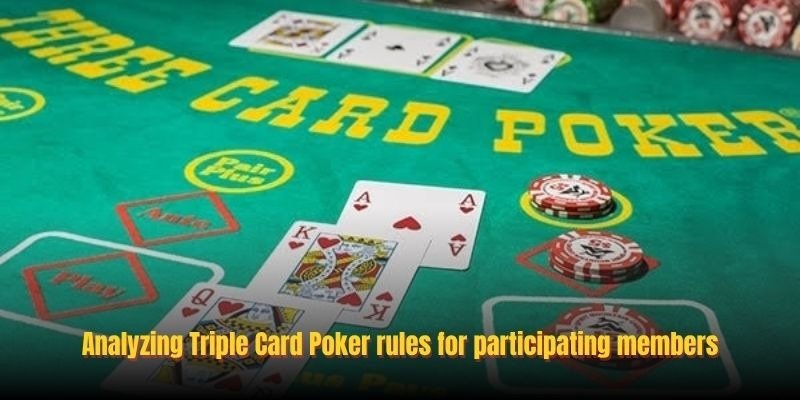
Analyzing Triple Card Poker rules for participating members
Statistical analysis of Triple Card Poker payout structures
Comprehending payout ratios remains critical for participants analyzing potential returns across various strategic approaches systematically. Establishing a baseline expectation allows individuals to evaluate risk exposure mathematically prior to committing chips. The following chart breaks down standard go88 reward multipliers applied directly to winning secondary combinations.
| Combination Type | Reward Multiplier Details |
| Straight Flush | This extremely rare sequence typically grants a massive return multiplier of 40 to 1 instantly. Acquiring this hand during Triple Card Poker ensures maximum profitability for the lucky participant involved. |
| 3 Matching | Getting 3 identical numerical values awards a strong 30 to 1 ratio upon successful completion. This outcome significantly boosts overall session balances without requiring sequential order from the dealt elements. |
| Regular Straight | Forming consecutive numbers without matching suits provides a reliable 6 to 1 overall investment multiplier. Participants often rely on this specific tier to maintain stable chip stacks across multiple rounds. |
| Standard Flush | Gathering 3 identical suits randomly yields a modest 4 to 1 payout ratio consistently throughout. This outcome appears frequently enough to sustain ongoing engagement during prolonged mathematical evaluation periods typically. |
| Minimum Pair | Holding any basic pair ensures a simple 1 to 1 return on the side investment. It serves as the absolute baseline requirement to extract value from the optional bonus wager. |

Statistical analysis of Triple Card Poker payout structures
Evaluating advanced mathematical patterns during digital table sessions
Recognizing subtle statistical shifts on go88 enables participants to adapt their risk tolerance dynamically always. Consistent observation during Triple Card Poker provides valuable data for adjusting future chip allocation effectively.
Implementing progressive allocation scaling techniques
Adjusting wager sizes based on previous outcomes represents a highly debated mathematical approach among analysts.
- Increasing investments following consecutive losses attempts to recover deficits rapidly through a single successful round.
- This specific methodology requires substantial reserve balances to withstand extended periods of unfavorable card distributions.
- Decreasing amounts after victories protects accumulated profits while minimizing exposure during subsequent unpredictable deal sequences.
Identifying random number generator distributions
Digital platforms utilize complex algorithms explicitly designed to simulate perfectly randomized deck shuffling procedures continuously.
- These systems eliminate mechanical biases entirely while ensuring absolute fairness across millions of simulated hands.
- Attempting to predict exact short term sequences remains mathematically impossible due to the algorithm structure.
- However, understanding standard Triple Card Poker probabilities allows individuals to make logically sound choices regardless.
Comparing side bets versus primary wagers
Participants evaluating Triple Card Poker must balance focus between mandatory confrontations and optional bonus mechanisms.
- The primary matchup features a significantly lower house edge compared to the highly lucrative side options.
- Relying strictly on bonus payouts introduces extreme volatility into the overall mathematical session trajectory constantly.
- A balanced approach allocates smaller portions to side mechanics while maintaining strong central hand investments.
Developing systematic decision making frameworks
Removing emotional reactions entirely on go88 guarantees maximum adherence to proven mathematical boundary guidelines consistently.
- Setting strict quantitative variance boundaries prevents individuals from extending participation during unexpected negative statistical downward swings.
- Calculating theoretical peak points guarantees participants secure accumulated chips instead of risking them on improbable sequences.
- Executing Triple Card Poker rounds requires robotic precision rather than relying on inconsistent subjective feelings.
Analyzing long term yield expectancies
Calculating theoretical returns helps establish realistic milestones for dedicated individuals analyzing data over extended periods.
- Every available structural decision carries a specific mathematical value that influences the final aggregate outcome.
- Consistent optimal play in Triple Card Poker minimizes the structural advantage inherent within the system.
- Participants who deviate from established baseline strategies inevitably accelerate their expected deficit accumulation rate severely.

Evaluating advanced mathematical patterns during digital table sessions
Consolution
Triple Card Poker presents an intricate numerical puzzle disguised as a fast paced card matching competition. Operating analytical frameworks when tải go88 demands immense logical discipline rather than relying upon fleeting luck. Executing mathematically proven strategies transforms chaotic dealing sequences into an orderly environment for quantitative deduction.
